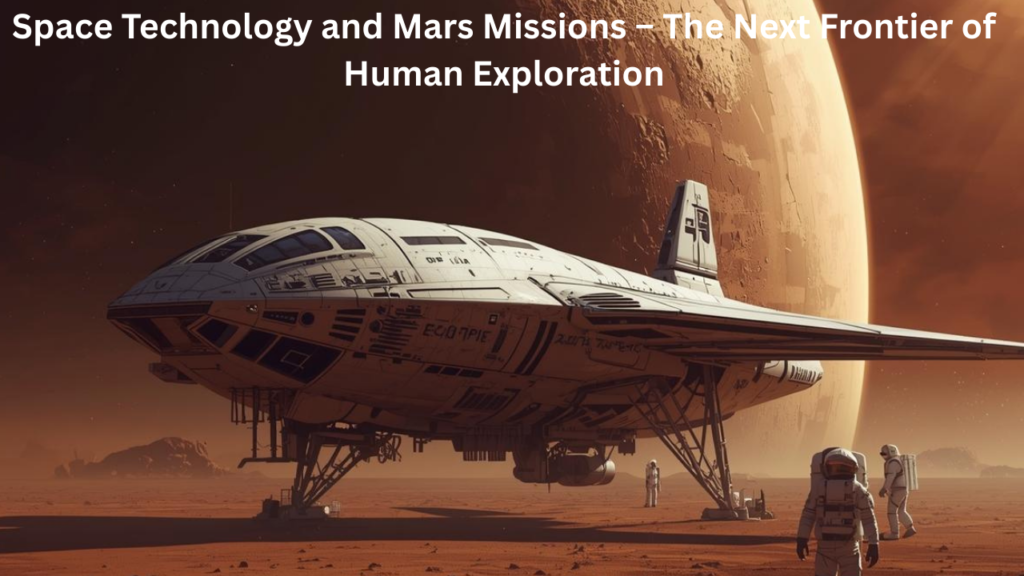
Humanity has always looked toward the stars with curiosity and ambition. From the first satellite launch to landing on the Moon, space exploration has defined technological progress for decades. Today, space technology is advancing faster than ever, with new missions targeting Mars, deep space exploration, and even the possibility of human settlement beyond Earth.
Modern space exploration is no longer limited to government agencies. Private companies are now playing a crucial role in reshaping the future of space travel. In this article, we will explore the evolution of space technology, Mars missions, private sector involvement, challenges, and the long-term vision for interplanetary life.
The Evolution of Space Technology
Space exploration began during the Cold War era, when nations competed to achieve milestones in orbit and beyond. Over time, technology improved dramatically.
Early missions focused on:
- Launching satellites
- Human spaceflight
- Moon exploration
Today, space agencies like NASA and private companies such as SpaceX are pushing the boundaries of what is possible.
Advancements in computing, robotics, materials science, and propulsion systems have made space missions more efficient and cost-effective.
Why Mars?
Mars has become the primary target for future exploration due to several reasons:
- It has seasons and weather patterns.
- Evidence suggests water once existed there.
- It has a day length similar to Earth.
- It may support future human settlement.
Scientists believe that studying Mars can help answer one of humanity’s biggest questions: Has life ever existed beyond Earth?
Robotic Missions to Mars
Before humans can travel to Mars, robotic missions are paving the way.
Mars rovers have successfully:
- Collected soil samples
- Analyzed atmospheric composition
- Searched for signs of ancient life
- Mapped the Martian surface
NASA has launched several successful Mars missions, including rovers designed to explore the planet’s geology and climate history.
These missions provide valuable data that helps prepare for future human exploration.
The Rise of Private Space Companies
In recent years, private companies have transformed the space industry.
SpaceX has developed reusable rockets, significantly reducing the cost of launching payloads into orbit. Reusability is one of the biggest breakthroughs in space technology, making frequent missions more economically feasible.
Other companies are also working on satellite networks, lunar missions, and deep-space exploration.
The involvement of private firms has accelerated innovation and created competition in the space sector.
Reusable Rocket Technology
Traditional rockets were single-use, making space travel extremely expensive. Reusable rockets can land back on Earth after launch and be used again.
Benefits include:
- Lower mission costs
- Increased launch frequency
- Greater sustainability
This innovation is critical for long-term Mars missions, which require massive resources and repeated launches.
Human Mission to Mars
Sending humans to Mars is one of the most ambitious goals in modern science.
Challenges include:
- Long travel time (6–9 months)
- Radiation exposure
- Psychological isolation
- Limited life-support resources
- Safe landing on Mars
Scientists are developing advanced spacecraft, life-support systems, and habitat modules to make human missions possible.
A successful human Mars mission would mark one of the greatest achievements in history.
Space Technology Beyond Mars
Space exploration is not limited to Mars. Future missions aim to:
- Establish lunar bases
- Mine asteroids for resources
- Explore outer planets
- Search for habitable exoplanets
Advanced telescopes allow scientists to observe distant galaxies and potentially discover Earth-like planets.
Space Technology and Everyday Life
Space innovation also benefits life on Earth.
Technologies developed for space missions have contributed to:
- GPS systems
- Satellite communication
- Weather forecasting
- Medical imaging
- Water purification systems
Space research drives technological progress that impacts daily life.
Economic Opportunities in Space
The space industry is becoming a trillion-dollar economy.
Emerging sectors include:
- Satellite internet services
- Space tourism
- Asteroid mining
- Space-based manufacturing
Companies are planning commercial space stations and tourist missions beyond Earth’s atmosphere.
International Cooperation in Space
Space exploration increasingly involves global collaboration. Countries work together on projects such as:
- Space stations
- Research missions
- Data sharing
International cooperation reduces costs and promotes peaceful scientific advancement.
The Vision of a Multi-Planetary Civilization
Some experts believe humanity must become a multi-planetary species to ensure long-term survival. Natural disasters, climate change, or global crises could threaten life on Earth.
Establishing a sustainable presence on Mars could serve as a backup for civilization.
Although this goal may take decades, rapid technological advancements are bringing it closer to reality.
Challenges and Ethical Questions
While space exploration offers immense promise, it also raises ethical questions:
- Who owns space resources?
- Should Mars be protected from contamination?
- How will space activities be regulated?
International laws must evolve to address these issues responsibly.
The Future of Space Exploration
The future of space technology may include:
- Nuclear-powered propulsion systems
- Artificial gravity habitats
- Self-sustaining space colonies
- Advanced AI-controlled spacecraft
As innovation continues, space travel may eventually become more accessible to ordinary citizens.
Conclusion
Space technology represents one of humanity’s most exciting frontiers. With agencies like NASA leading scientific missions and companies like SpaceX revolutionizing rocket technology, the dream of reaching Mars is becoming increasingly realistic.
From robotic exploration to the possibility of human settlement, space innovation is reshaping our understanding of the universe and our place within it.