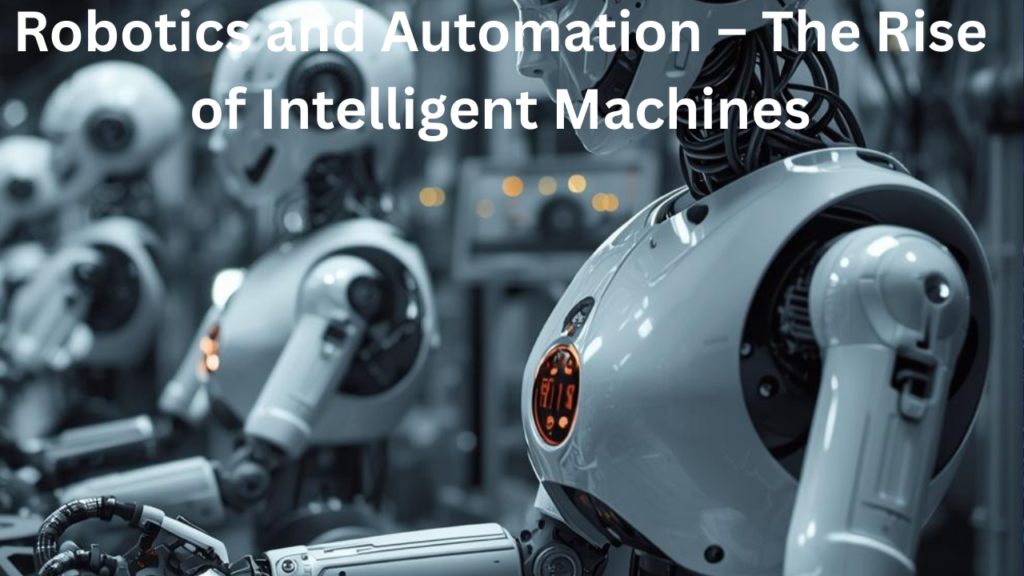
The 21st century is witnessing a rapid transformation in industries, workplaces, and daily life due to robotics and automation. Machines are no longer just tools—they are becoming intelligent collaborators capable of performing complex tasks with precision, speed, and efficiency. From manufacturing floors to hospitals, from autonomous vehicles to household robots, automation is redefining how humans live and work.
In this article, we will explore the evolution of robotics, the role of automation in modern industries, emerging technologies, challenges, and what the future holds for intelligent machines.
What Are Robotics and Automation?
Robotics is the branch of technology focused on designing, building, and operating robots—machines capable of performing tasks automatically or under human control.
Automation refers to using technology to perform tasks without human intervention. While robotics often involves physical machines, automation also includes software-driven processes such as AI-powered systems, workflow automation, and robotic process automation (RPA).
Leading companies like Boston Dynamics and ABB are pioneering both industrial and service robotics.
The Evolution of Robotics
Robotics has evolved in multiple stages:
- Industrial Robots (1960s–1980s) – Machines that performed repetitive tasks on manufacturing lines.
- Service Robots (1990s–2010s) – Robots for healthcare, cleaning, and customer service.
- Intelligent Robots (2010s–present) – AI-powered robots capable of decision-making, learning, and collaboration with humans.
The integration of AI, sensors, and advanced actuators is enabling robots to perform tasks that were once considered uniquely human.
Applications of Robotics and Automation
1. Manufacturing and Industry
Robotics has transformed the manufacturing sector by improving efficiency, reducing costs, and enhancing precision.
- Automotive assembly lines use robotic arms for welding, painting, and quality control.
- Electronics production relies on robots for soldering and assembly.
- Material handling and logistics are increasingly automated using autonomous guided vehicles (AGVs).
Automation allows companies to maintain high production standards while minimizing human error.
2. Healthcare and Medical Robotics
Robots are revolutionizing healthcare:
- Surgical robots enable minimally invasive procedures with high precision.
- Rehabilitation robots assist patients in recovering mobility.
- AI-powered diagnostic robots analyze medical data to detect diseases early.
Hospitals worldwide are adopting robotics to enhance patient care and reduce operational workloads.
3. Autonomous Vehicles and Drones
Robotics is central to autonomous transportation:
- Self-driving cars use sensors, AI, and robotics to navigate roads safely.
- Delivery drones transport packages in urban areas.
- Agricultural robots automate planting, harvesting, and monitoring crops.
These technologies improve efficiency while reducing human labor and risk.
4. Service and Household Robots
Robots are entering homes and businesses:
- Vacuuming robots and smart home assistants make daily tasks easier.
- Customer service robots in hotels and airports assist guests.
- Companion robots provide social interaction and support for the elderly.
Consumer robotics is expanding rapidly, offering convenience and new experiences.
5. Space Exploration
Robots play a crucial role in space:
- Rovers explore Mars and other celestial bodies.
- Robotic arms maintain satellites and space stations.
- Autonomous spacecraft perform deep-space missions.
Companies like NASA and SpaceX use robotics to achieve tasks too dangerous or impossible for humans.
Benefits of Robotics and Automation
- Increased Productivity: Robots work continuously without fatigue.
- Higher Accuracy: Automation reduces human errors.
- Safety: Dangerous tasks are handled by machines instead of humans.
- Cost Reduction: Long-term labor costs decrease with automation.
- Innovation: Robots enable tasks and experiments that were previously impossible.
Industries adopting intelligent machines are gaining a competitive advantage in efficiency and innovation.
Challenges and Concerns
Despite its benefits, robotics and automation raise several challenges:
1. Job Displacement
Automation can replace repetitive and manual jobs, creating employment concerns.
2. High Initial Costs
Advanced robotic systems require significant upfront investment.
3. Security Risks
Connected robots and automated systems can be vulnerable to cyberattacks.
4. Ethical and Social Implications
Human-robot interaction raises questions about safety, accountability, and social impact.
Addressing these challenges requires careful planning, workforce reskilling, and regulatory oversight.
The Role of Artificial Intelligence in Robotics
AI and robotics are closely linked:
- Machine Learning allows robots to learn from experience.
- Computer Vision enables robots to “see” and interpret environments.
- Natural Language Processing allows robots to understand and respond to human speech.
Intelligent robots are evolving from programmed machines to adaptive collaborators, capable of working alongside humans in dynamic environments.
The Future of Robotics and Automation
The next decade may bring:
- Fully autonomous factories and warehouses
- AI-powered personal assistants capable of complex decision-making
- Swarms of collaborative drones for logistics, agriculture, and surveillance
- Humanoid robots in healthcare, education, and hospitality
- Integration of robotics with IoT and 5G for seamless smart environments
These advancements will redefine productivity, convenience, and innovation across all sectors.
Conclusion
Robotics and automation represent a major technological revolution with far-reaching implications. Companies like Boston Dynamics and ABB are leading the development of intelligent machines capable of enhancing human productivity and improving quality of life.
While challenges such as job displacement, security risks, and ethical concerns remain, the future of robotics promises smarter, faster, and safer systems across industries, homes, and even outer space.