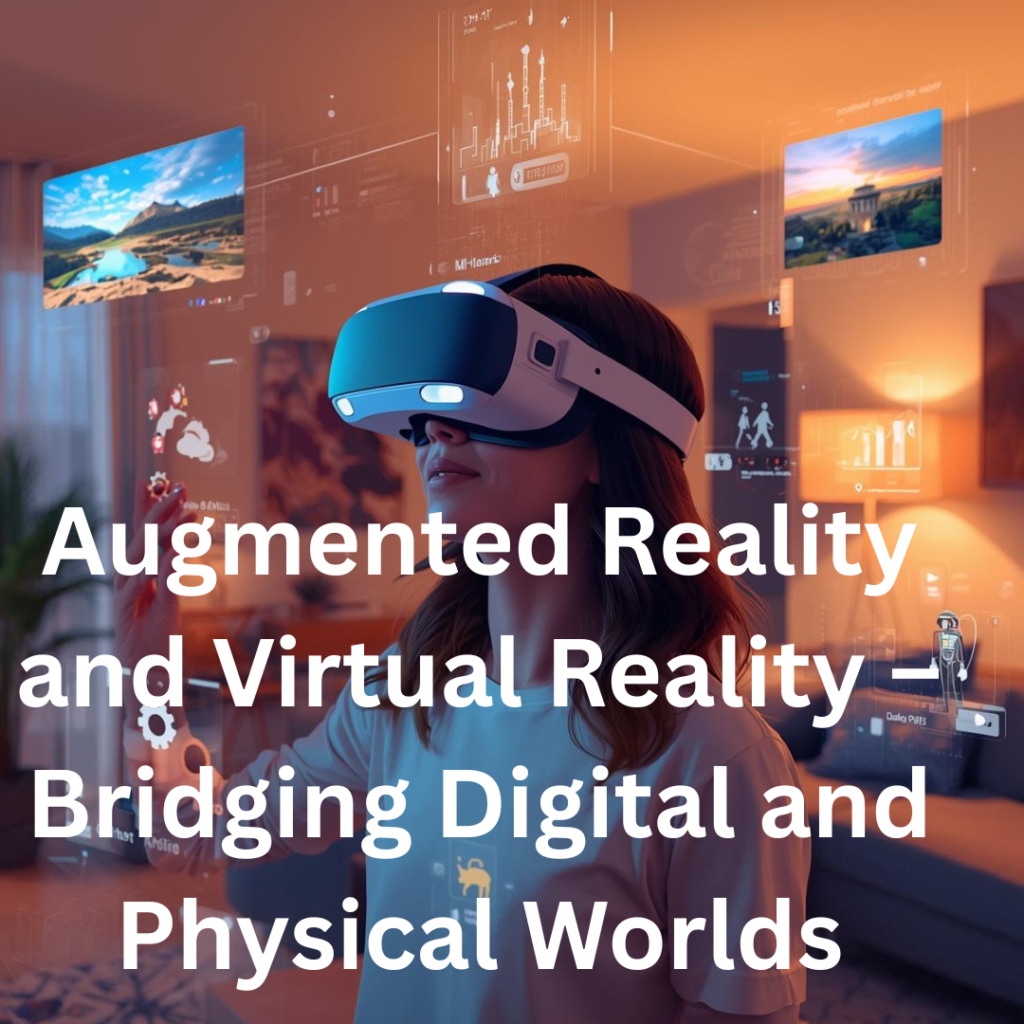
In recent years, Augmented Reality (AR) and Virtual Reality (VR) have emerged as revolutionary technologies that are changing how we interact with digital content. While VR immerses users in entirely virtual environments, AR overlays digital elements onto the real world. Together, these technologies are transforming gaming, education, healthcare, retail, and even industrial operations.
In this article, we will explore what AR and VR are, their differences, applications across industries, benefits, challenges, and the future of immersive technologies.
Understanding Virtual Reality (VR)
Virtual Reality is a technology that creates a fully immersive digital environment, allowing users to experience and interact with a computer-generated world. VR typically requires:
- Headsets – Devices such as Oculus or HTC Vive.
- Controllers and Sensors – Track hand movements and physical actions.
- High-Performance Computers – Render realistic 3D environments.
VR immerses users in a simulated reality, making them feel physically present within the digital world.
Understanding Augmented Reality (AR)
Augmented Reality overlays digital information onto the real world, enhancing perception and interaction. AR can be experienced through:
- Smartphones and Tablets – Apps like Pokémon Go or IKEA Place.
- AR Glasses – Devices that project information onto the user’s field of view.
- Industrial AR Systems – Hands-free support for technicians and engineers.
Unlike VR, AR does not replace reality but enhances it with digital elements.
Key Differences Between AR and VR
| Feature | Virtual Reality (VR) | Augmented Reality (AR) |
|---|---|---|
| Environment | Fully simulated digital world | Real world with digital overlays |
| Hardware | VR headsets, motion sensors | Smartphones, tablets, AR glasses |
| Immersion | Complete immersion | Partial immersion |
| Applications | Gaming, training, simulations | Navigation, industrial assistance, retail |
Applications of AR and VR
1. Gaming and Entertainment
VR provides fully immersive gaming experiences, allowing players to feel part of the action. AR enhances mobile games by blending digital content with real-world surroundings.
2. Education and Training
- VR classrooms allow students to explore historical events or scientific phenomena.
- Medical training uses VR simulations for surgical practice.
- AR overlays assist technical training in engineering, aviation, and machinery maintenance.
Immersive learning improves engagement and retention.
3. Healthcare
AR and VR improve medical care:
- VR helps patients manage pain and anxiety.
- AR assists surgeons by projecting vital information during procedures.
- VR simulations train medical professionals safely without risks.
These technologies enhance both patient care and professional training.
4. Retail and Marketing
- AR apps allow customers to virtually try on clothes, makeup, or furniture.
- VR can create virtual showrooms and immersive brand experiences.
- Interactive AR campaigns engage consumers in new and innovative ways.
These technologies enhance customer engagement and drive sales.
5. Industrial and Manufacturing
AR and VR support industrial operations:
- VR simulates factory layouts and workflows for planning.
- AR guides workers in complex assembly tasks, reducing errors.
- Remote collaboration uses AR/VR to connect experts worldwide.
This reduces operational costs and improves efficiency.
6. Real Estate and Architecture
- VR allows virtual property tours, saving time for buyers and agents.
- AR overlays design plans onto real-world spaces, helping architects and clients visualize projects.
Immersive visualization improves decision-making and client engagement.
Benefits of AR and VR
- Enhanced Learning and Training – Immersive simulations improve understanding.
- Increased Engagement – Interactive experiences captivate users.
- Improved Efficiency – AR assists in precise, real-time operations.
- Cost Savings – VR training reduces the need for physical resources.
- Innovation – Creates new opportunities in entertainment, marketing, and design.
Challenges and Limitations
While AR and VR have immense potential, they face several challenges:
1. High Costs
Quality VR headsets, AR glasses, and supporting hardware can be expensive.
2. Health Concerns
Prolonged VR use may cause motion sickness, eye strain, or disorientation.
3. Technical Limitations
High-resolution immersive experiences require powerful computing, high-speed internet, and advanced graphics.
4. Content Creation
Developing engaging AR/VR content is complex and resource-intensive.
Future of AR and VR
The future of AR and VR includes:
- Mixed Reality (MR): Combining AR and VR for seamless interaction between real and digital worlds.
- AI Integration: Smarter avatars, adaptive simulations, and personalized experiences.
- Wearable AR Glasses: Lightweight, stylish devices for daily use.
- Enterprise Applications: Virtual collaboration, remote support, and immersive analytics.
- Expanded Gaming and Entertainment: Fully immersive metaverse experiences.
These innovations will make AR and VR an integral part of both professional and personal life.
Conclusion
Augmented Reality and Virtual Reality are bridging the gap between the digital and physical worlds. Companies like Oculus are leading innovations that create immersive experiences for education, healthcare, entertainment, and industry.
Despite challenges such as cost, health concerns, and technical limitations, the potential of AR and VR is enormous. These technologies are not just enhancing experiences—they are reshaping how we work, learn, interact, and perceive reality.